
Jib Cranes
Products for category Jib Cranes
Jib Cranes
Jib Cranes lift and position loads within a fixed work area. The arm, sometimes called a boom, rotates through a set arc, so it gives dedicated lifting at a single station without taking up much floor.
Jib cranes take a range of attachments, including hoists, tool balancers, air balancers, and vacuum lifters, to match the task. The four jib crane types each suit a different load and work area. Here’s how they compare.
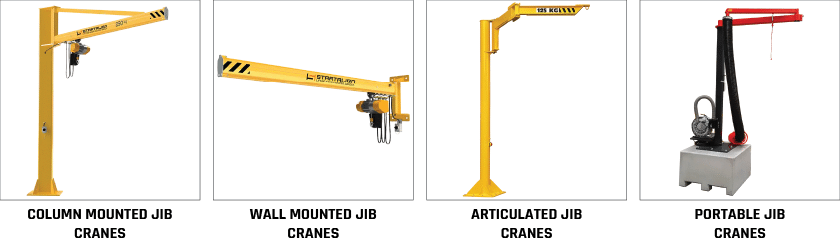
| Jib Crane Type | Best Installation Scenario | Capacity Range | Reach & Rotation | Fixing Requirements | Typical Industries |
|---|---|---|---|---|---|
| Column mounted | Fixed workstation, widest coverage, indoor or outdoor | Up to 10,000 kg | 2 to 12 m jib, up to 360° | Anchored to a concrete floor foundation | Fabrication, steelworks, loading docks |
| Wall mounted | Against a wall or column, saves floor space | Up to 4,000 kg | 2 to 7 m jib, up to 180° | Brackets to a wall, column, or beam; no foundation | Automotive, fabrication, manufacturing |
| Articulated | Reaching around columns, walls, or machinery | Follows its wall or column base | Two arms for movement around obstructions | Wall or column mounted | Fabrication bays, assembly, maintenance |
| Portable | Moves between work areas, no permanent install | Up to 500 kg | 2 to 6 m jib, rotating column | None; concrete ballast base, forklift-movable | Construction, warehousing, manufacturing |
Column Mounted Jib Cranes
A column-mounted jib crane stands on its own floor-fixed column, giving the widest coverage of the four types. It rotates up to a full 360° and lifts up to 10,000 kg, with a jib reaching out to 12 m. It is the most versatile option for a fixed workstation. The column-mounted jib crane range covers full-rotation and braced I-beam builds for indoor or outdoor use.
Wall Mounted Jib Cranes
A wall-mounted jib crane fixes to a wall or an existing building column, so it frees up the floor and can fold clear of an overhead crane. It rotates through a semi-circular arc of up to 180° and handles loads up to 4,000 kg across a 2 to 7 m reach. See the wall-mounted jib crane range for braced I-beam and enclosed profile options.
Articulated Jib Cranes
An articulated jib crane uses two pivoting arms instead of one, so the load can reach around columns, walls, or machinery. It suits confined bays and precise positioning where a straight arm would be blocked. Both articulated jib crane builds mount to a wall or column and pair with an electric chain hoist or vacuum lifter.
Portable Jib Cranes
A portable jib crane sits on a reinforced concrete ballast base rather than a fixed foundation, so a forklift can reposition it around a site. It lifts up to 500 kg and needs no anchoring or structural changes. This is the option for portable jib cranes on a mobile concrete base where the work area changes from job to job.
Choosing Between a Jib Crane and a Gantry Crane
A jib crane serves one fixed work area. A gantry crane covers a whole bay or production line. The right choice comes down to how far your loads travel and how much floor you need to cover.
Choose a jib crane when lifting happens at a single station, such as a machine, a weld bay, or a loading point. A jib holds a small footprint and rotates within a set arc, so it handles dedicated tasks without taking over the floor.
Choose a gantry or overhead crane system when loads move along a line or across a full work area. A workstation bridge crane covers a rectangular zone rather than a circle, which suits repetitive travel between stations. Many New Zealand sites run both, with jib cranes handling local lifts under a larger gantry.
Find the Right Jib Crane for Your Site
The right jib crane depends on your loads and how your work area is laid out. Browse the wall-mounted, column-mounted, articulated, and portable ranges below, or talk it through with our team. Book a consultation, and we will match the crane to the job.


Product Search…
Products
-
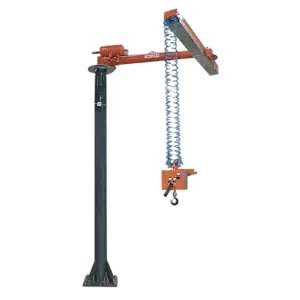 Pneumatic Manipulator - ATISacer-55
Request Pricing
See Specifications Below.
-
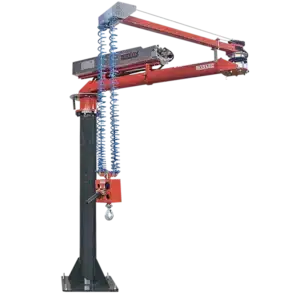 Pneumatic Manipulator - ATISacer-150
Request Pricing
See Specifications Below.
-
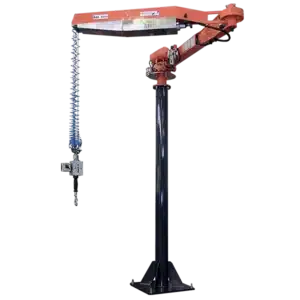 Pneumatic Manipulator - ATISacer-80
Request Pricing
See Specifications Below
-
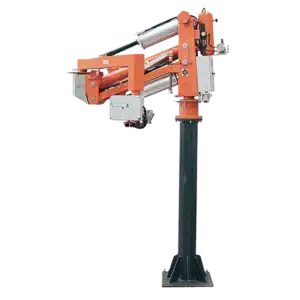 Pneumatic manipulator with articulated rigid arms - ATISmirus-500
Request Pricing
See Specifications Below.
-
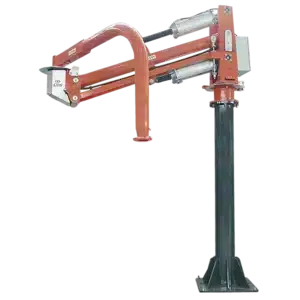 Pneumatic manipulator with articulated rigid arms - ATISmirus-300
Request Pricing
See Specifications Below.